 Join session
The Friday Stillness Gate: Your Daoist Meditation Practice
Online via Google Meet. Arrive a few minutes early and give yourself permission to settle.
You do not have to travel far to meet stillness. You only have to become available to it.
Rooted in Tai Chi, Qigong and Daoist internal cultivation, each session explores the living relationship between body, breath, mind and Qi.
No previous experience is needed. Bring the person you are today, not the person you believe you ought to be.
“Peace is not something you must manufacture. When striving softens, you may begin to recognise the quiet that was already there.”
When the world is loud, listen more deeply.
Life continually asks for our attention. The mind plans and replays, while the body quietly carries the pressure of everything left unfinished.
This practice does not ask you to eliminate thought or pretend to be calm. It helps you witness thoughts, emotions and sensations with enough awareness to create a little space between what happens and how you respond.
Nothing within you exists alone.
Daoist meditation understands that posture, breathing, attention, awareness and Qi belong to one living whole. A change in one can be felt throughout the others.
As unnecessary effort softens, the breath often becomes more natural. As breathing settles, the mind may become less restless. Presence is not achieved by force. It is revealed through cooperation.
Ancient insight. Modern enquiry.
Evidence continues to develop, and every person responds differently. This practice is offered for wellbeing and is not a substitute for medical care.
What contemplative traditions have explored through experience, modern research now examines through careful enquiry. Studies suggest meditation and Qigong may support attention regulation, stress management, emotional awareness and connection between mind and body.
Systematic reviews indicate potential benefits for stress-related outcomes, while also noting that the size and quality of studies vary. Research can point toward possibility, but it cannot promise the same outcome for every person.
Your guide
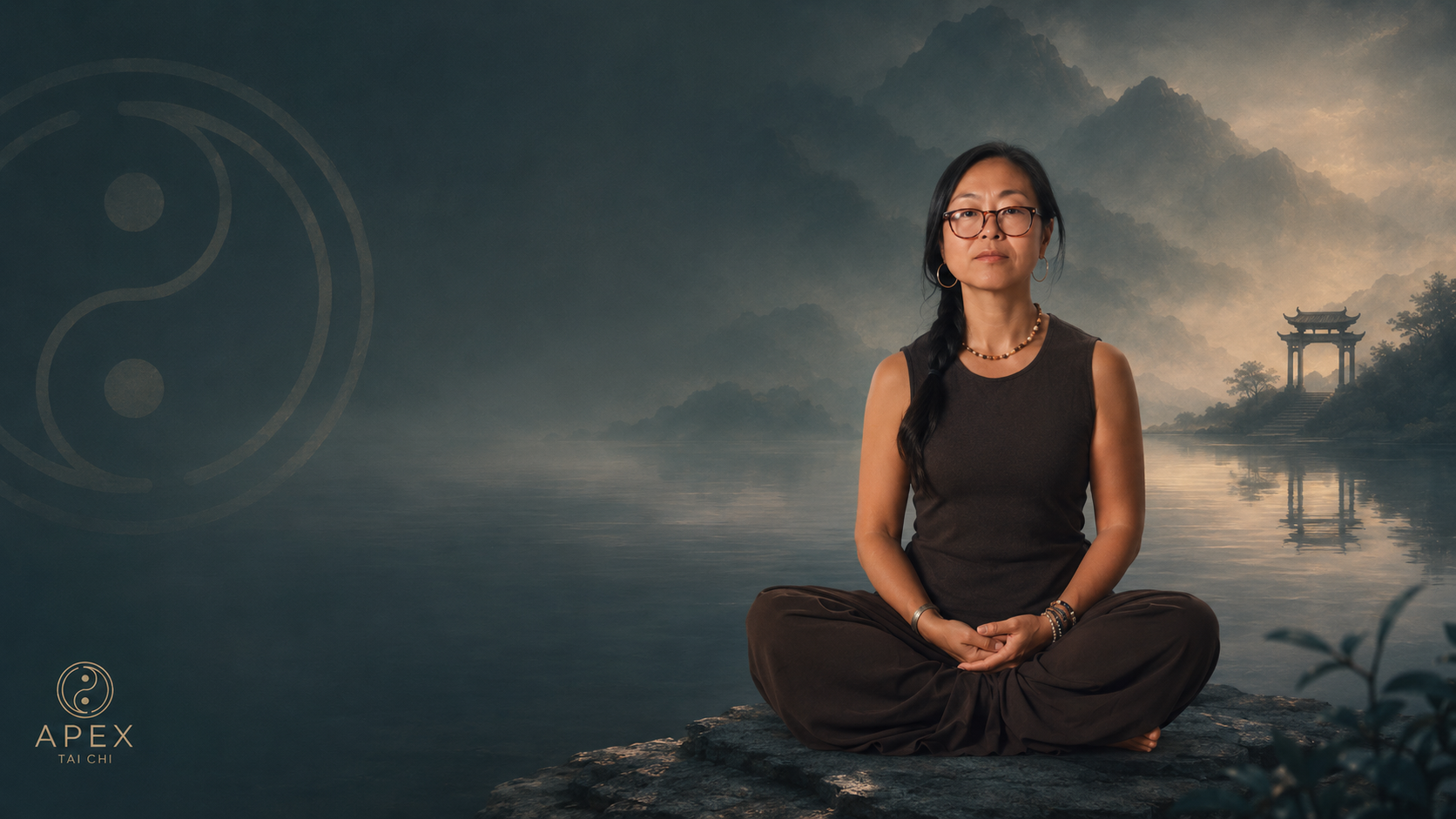
About Dr Jar
Dr Wenxia Jar is a qualified Authentic Tai Chi and Qigong instructor whose training and teaching began in China. For more than twenty years, she worked as both a practitioner and university lecturer, bringing rigorous scholarship together with sustained practical instruction.
Her teaching combines classical Daoist principles with a modern understanding of nervous system regulation, cognitive resilience and recovery. Known for clarity, discretion and compassionate attention, she helps each person cultivate greater calm, balance and inner awareness at a pace that respects the individual.
Discover more about Dr JarBegin with the moment that is already here.
There is no perfect posture and no prize for forcing concentration. Each session is guided gently, with space to listen to your body and adapt the practice to your own comfort.
- Settling the body
- Natural breathing awareness
- Guided meditation
- Observing thoughts and emotions
- Body awareness
- Daoist-inspired stillness
- Quiet reflection
Who this practice is for
For anyone moving through a busy life, carrying mental overload or longing for a deeper sense of wellbeing. Curiosity is enough. If you feel drawn toward greater calm, clarity and connection, the practice can meet you there.
Create the space, then enter it.
A few simple choices can tell the body that it is safe to slow down. Prepare without hurry, then let the preparation go.
- Choose a safe, quiet and comfortably warm place.
- Dim the lights and silence notifications.
- Wear loose, comfortable clothing.
- Avoid a heavy meal immediately beforehand.
- Keep some water nearby if you wish.
- Let others know you prefer not to be interrupted.
- Join a few minutes early so you can settle.
- Use headphones if they help you hear clearly.
Let gentleness be the way.
You do not need a perfect posture or an empty mind. Comfort, awareness and the willingness to return are enough.
Find a comfortable position+
Let your position be an act of kindness toward the body. Sit on a supportive chair or use a meditation cushion if that is already comfortable for you.
Place both feet comfortably on the floor. Allow the spine to rise without becoming rigid. Rest the hands, soften the shoulders, jaw and face, then close the eyes lightly or use a relaxed downward gaze.
Work with the breath+
The breath already knows how to breathe. Unless specific guidance is offered, let it remain natural and release the need to control its rhythm.
Notice each breath without asking it to be different. If this feels uncomfortable, return to the contact of your feet with the floor, the support of the chair, or the sounds in the room.
Meet thoughts and emotions+
Thoughts, plans and emotions will arise because that is what minds do. Their arrival is part of the practice, not a failure within it.
When attention wanders, notice where it has gone and return gently to the guidance, the breath or the body. Each return is a quiet choice to begin again.
Close with awareness+
When the guidance ends, resist the urge to rush back into activity. Give yourself a few moments to notice the body, the breath and the quality of your mind.
Remain seated, take some water or make a short note. A peaceful session and a restless session can both reveal something useful when neither is judged.
Listen to your body
Your body is part of the wisdom.
This particular meditation should never require you to endure pain or distress. You are always free to adjust your position, open your eyes, stand up, pause or leave the practice.
If emotion becomes overwhelming, return to the room, feel your feet on the floor and let the breath be natural. Pausing is not stepping away from the practice. It is practising respect for yourself. Follow any medical guidance relevant to your health.
Developing a regular practice
Return with patience, not pressure.
No two sessions need to feel the same. Arrive, listen and meet what is present. With familiarity, you may begin to notice that stillness is not separate from daily life. It is a quality you can carry into it.
Where attention goes, Qi follows.Reflection“Let the body soften and the breath find its own rhythm. Watch the mind with compassion.
Awareness deepens when nothing within you is pushed away.”
An open invitation
No fixed fee.
Contribute only if it feels right.
The Friday Stillness Gate is offered without a fixed session fee because the invitation to become still should remain open. If the practice supports you and you feel moved to sustain it, you are warmly invited to contribute an amount that feels right.
Optional donationMake a contribution↗Secure payment via Stripe. Contribution is entirely optional and is not required to attend.Every Friday · Online
The gate is open.
7:00 to 7:45 pm UK time45-minute guided meditation
Step away from the noise.
Return to the present.
Remember the awareness already alive within you.